
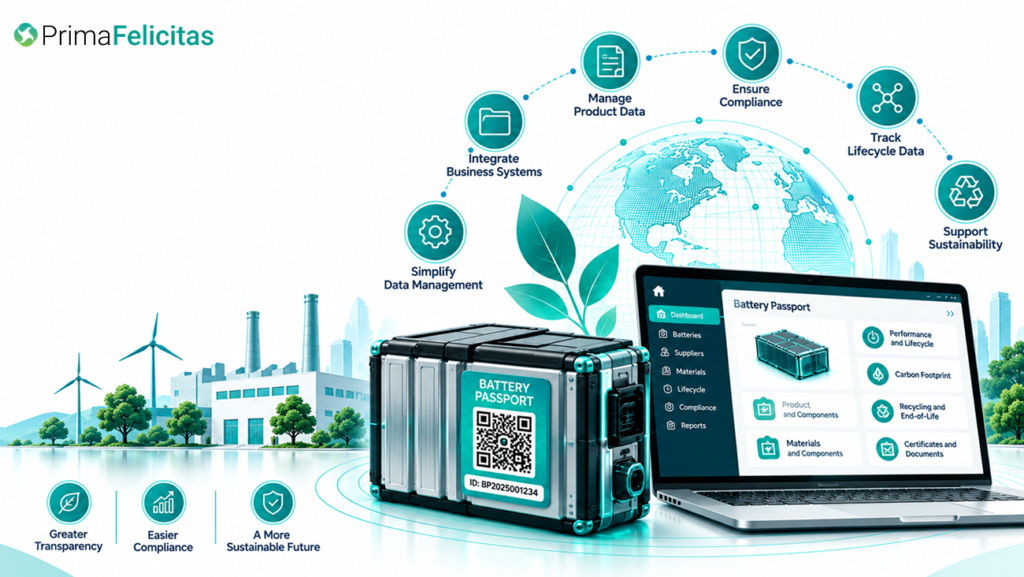
Battery Passport software assists the battery business to deal with product data, compliance information, lifecycle data and digital passport specifications. It integrates key battery data into a single software platform. This may make data collection, validation, management of contributors and compliance preparation simple to European battery businesses.
The software also has the capability of integrating with the existing business systems and keeping records as batteries go through their lifecycle. This document describes the type of information that the software can handle, the format of battery data, and the creation of digital passports. It additionally addresses identifiers, integrations, compliance evidence, and implementation audits.
What Information Can Be Uploaded to Battery Passport Software?
Battery passport software is capable of handling various types of information that are related to a battery. This type of information will depend on the type of battery, requirements, and the business process.
Ordinary categories of information may be:
- Battery recognition and battery maker data.
- Battery type and technical characteristics.
- The battery capacity and performance are presented.
- Information of materials and components.
- Supply-chain and supplier information.
- Carbon footprint information
- Sustainability-related information
- Durability and performance records
- Usage and life cycle data.
- Recycling and end of life information.
- Certificates, statements and supporting documents.
The platform will be able to arrange such details into organized digital records. The relevant battery or information category can also be supported by relevant documents.
This simplifies the process of locating, validating, updating, and utilizing information when compliance processes are undertaken.
How Is Battery Data Structured?
Before battery data can be used to aid traceability and passport management, it must have a clear structure. Information about individual batteries and relationships between them and other records can be organized using a software platform. A common layout has the potential to link:
- Battery
- Product
- Components
- Materials
- Suppliers
- Lifecycle Events
- Documents
Defined fields, relationships, and supporting information can be contained in each record. Businesses also have the ability to define what information is needed, the person(s) that provide it and the person who validates it. Data validation can be used to detect missing or incompatible data prior to the approval of records. This forms a more trustworthy information base of the Digital Battery Passport. A defined data model simplifies information retrieval as well when businesses require reporting, verification or evidence of compliance.
Can the software create a passport for each battery?
Yes. An appropriate platform will generate an online record of a passport that will be linked with every pertinent battery. It begins with a special battery name. The identity can then be linked to relevant technical, manufacturing, material, sustainability and lifecycle information. This information can be arranged using the software based on set data requirements. It is also able to correlate supporting documents and verification records with pertinent information. This gives a record in digital form that can be kept during the lifecycle of the battery.
The passport should be separated into the underlying system. The information and processes in the back of the passport are handled by battery passport software. The passport is the digital record organized in a structured format that is related to the battery.
Is there a QR code or digital identifier?
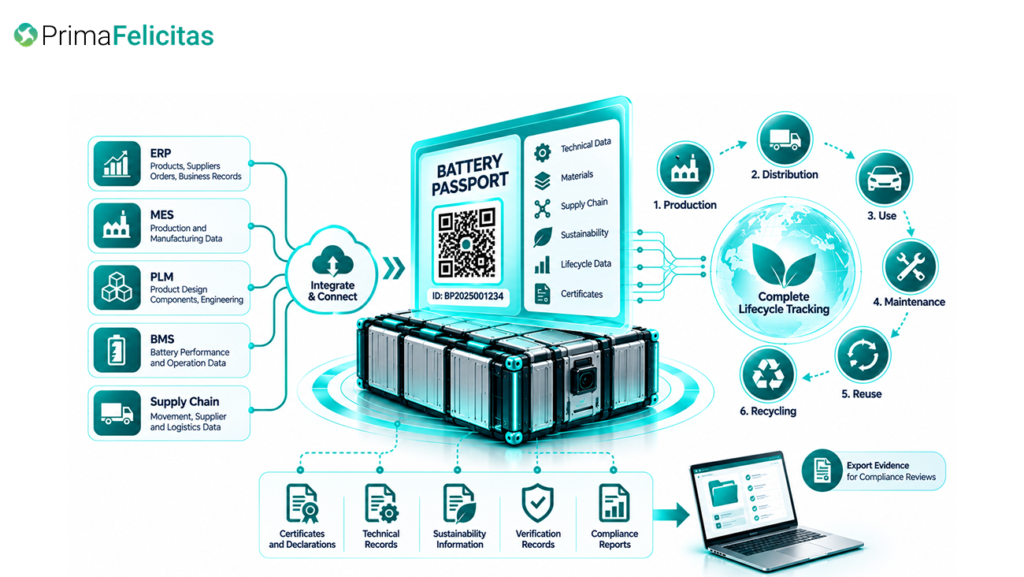
A digital battery passport must have a solid method of locating and retrieving the corresponding battery record. This may include a special digital address and, where necessary, access through QR. The identifier is able to identify the physical battery to the digital record associated with it. The corresponding digital environment then allows users to access pertinent information.
Access does not imply that all users can access all the available information. Role-based permissions have the ability to regulate the access of various users or contributors to information. The identifier thus serves as a linkage between the battery and its digital data. The software behind it takes care of the related records, permissions, updates and supporting data.
Can data be updated across the battery lifecycle?
Yes. Lifecycle updates are a significant component of a comprehensive traceability platform since battery information may vary following manufacturing. Information that is relevant may be kept at different stages as:
Stage 1: Production
Stage 2: Distribution
Stage 3: Use
Stage 4: Maintenance
Stage 5: Reuse
Stage 6: Recycling.
Information can be added by various contributors at various stages. Workflows can be established by businesses to submit such updates, review them, validate, and approve them. The platform is also able to retain record history and audit trails. This assists companies to know what was altered, who did something and the time something was done. This is to aid battery lifecycle tracking and maintain relevant information relating to the appropriate battery record.
Can the system connect with ERP, MES, PLM, BMS, or supply-chain systems?
Yes. A battery passport platform can be configured to communicate with the current business systems.
| Business system | Potential Information |
| ERP | products, suppliers, orders, business records |
| MES | Information on production and manufacturing |
| PLM | Information about products, design, components and engineering |
| BMS | Applicable battery performance and operation data |
| Supply chain systems | Movement supplier and logistics data |
Integration may eliminate duplicate data entry and bridge between the information already held by various teams. The passport platform can be integrated with the already established systems through APIs and integration layers to get pertinent information. Integration strategy must be reliant on business structure and information demands. This implies that none of the businesses is necessarily required to upgrade the current software. A battery traceability software platform is a connected layer that can be established to handle pertinent battery and compliance information.
Can Manufacturers Export Evidence for Compliance Reviews?
Yes. An integrated system ought to assist manufacturers to systematise and access evidence related to battery records and compliance efforts.
Evidence can include:
- Certificates and declarations
- Supplier documentation
- Technical records
- Sustainability information
- Verification records
- Approval history
- Data change history
- Compliance reports
- Supporting documents
These records may be associated with the corresponding battery, supplier, requirement or lifecycle event.
Audit trail may help to give extra visibility of changes and user activities. They can then allow businesses to access the relevant information without having to search through unrelated spreadsheets, emails and document folders.
The ability to export can also assist teams as they can compile evidence packages in an orderly manner which may either be reviewed internally or undergo external compliance audits.
Do You Provide an Audit Before Implementation?
Yes. An implementation audit may assist in identifying what your business requires prior to developing or deploying the platform. As part of the audit, your current systems, data sources, workflows, contributors, and compliance processes can be reviewed. It is also able to determine information gaps and integration needs.
An average evaluation is able to review:
- Existing battery data sources
- Current software systems
- Supplier and contributor processes.
- Data ownership and responsibilities.
- Compliance information requirements
- Existing documentation
- Integration requirements
- Lacuna in existing processes.
This establishes a feasible implementation plan. It assists in establishing what to be linked, what to be enhanced and what the ultimate platform should accommodate. This approach will be applicable in PrimaFelicitas to assist businesses in designing a battery passport software platform to support their current operations and compliance needs.
Battery Passport Software: Read at a Glance
| Requirement | Software Supported. |
| Battery information | Digital information and documents. |
| Data structure | The relationships are battery, product, component, supplier and lifecycle. |
| Digital passport | Passport records of concerned batteries. |
| Identification | Special online identifiers and QR-access. |
| Lifecycle updates | Continuous records, events and changes. |
| System integration | ERP systems, MES, PLM, BMS and supply-chain systems. |
| Compliance evidence | Paperwork, verification records, reports and audit history. |
| Implementation | Business, data, workflow, and integration analysis. |
Quick query about Battery Passport Software
What is battery passport software?
Battery passport software is an online application to handle battery data, battery lifecycle, and battery compliance data. It is able to facilitate the development and upkeep of electronic battery passport data.
Who needs battery passport software?
Software may be of use to businesses dealing with batteries that are subject to European Battery Passport. Certain requirements are based on the type of battery and the regulation.
What is in a battery passport?
Information may involve battery identification, technical specifications, materials, life cycle data, performance data, supply-chain data, and lifecycle data.
Is battery passport software compatible with existing business systems?
Yes. An appropriately developed platform would be able to integrate with ERP, MES, PLM, BMS, and supply-chain systems. Integration would help in decreasing repetitive data input as well as enhancing data continuity.
Is it possible to update battery passport data post-manufacturing?
Yes. The update of relevant information can be performed during the relevant lifecycle. These changes can be managed with workflows, permissions, validation and audit trails.
Conclusion
The digital basis of battery data, identifiers, lifecycle updates, integrations, and even compliance evidence can be offered by battery passport software. In the case of European battery businesses, the correct platform has the ability to link these processes rather than store the information in separate systems.
The solution ought to align with the current workflows and enable future compliance needs.
PrimaFelicitas might assist in evaluating your existing installation and create a battery passport framework on the basis of your business requirements.
