
What Are the EU Battery Passport 2027 Requirements?
From 18 February 2027, covered batteries placed on the EU market or put into service must have a battery passport that meets the requirements of the EU Batteries Regulation.
The requirement applies to:
- Electric vehicle batteries
- LMT batteries
- Industrial batteries above 2 kWh
The responsible economic operator must create and maintain the Battery Passport and ensure that the required information is accurate, complete, and up-to-date.
When Does the EU Battery Passport Become Mandatory?
The mandatory battery passport requirement starts on 18 February 2027.
| Date | Requirement |
| 20 July 2026 | EU DPP Registry Becomes Operation |
| 18 February 2027 | Battery Passport Becomes Mandatory |
| After 18 February 2027 | The passport must be operated and maintained |
Who Is Responsible for the EU Battery Passport?
The economic operator placing the covered battery on the EU market or putting it into service is responsible for the Battery Passport.
The responsible operator needs to:
- Create the Battery Passport
- Provide required information
- Ensure data accuracy
- Keep data complete and up to date
- Provide required access
- Maintain the Passport
- Upload the required unique identifier to the DPP Registry
What Data Is Required for the Battery Passport?
The Battery Passport must contain the information required by the Batteries Regulation and its applicable data requirements.
Key data areas include the following:
| Data Area | What It Covers |
| Identification | Battery and model identity |
| Technical data | Technical characteristics |
| Manufacturer data | Manufacturer and economic operator |
| Performance | Performance and durability |
| Sustainability | Sustainability information |
| Circularity | Repair, reuse, repurposing, and recycling |
| Individual battery | Battery-specific information |
| Lifecycle data | Relevant information generated during use. |
The European Commission published updated Battery Passport guidance on 21 August 2026, bringing together 71 data points and indicating their applicability across EV, LMT, and industrial batteries.
Does every battery passport data point apply to every battery?
No, the applicable data depends on the battery category and the relevant regulatory requirements. Manufacturers should therefore identify their battery category first before building their data model.
What Must Manufacturers Prepare Before 18 February 2027?
Manufacturers should have their data, identifiers, systems, and Battery Passport infrastructure ready.
- Scope: Identify covered batteries
- Operator: Identify the responsible economic operator
- Data: Collect required information
- Gaps: Find missing data
- ID: Define unique identifiers
- QR: Prepare the data carrier
- Architecture: Prepare the data structure
- Access: Define access rights
- Integration: Connect required systems
- Registry: Prepare registration
- Testing: Test the complete workflow
- Lifecycle: Plan ongoing updates
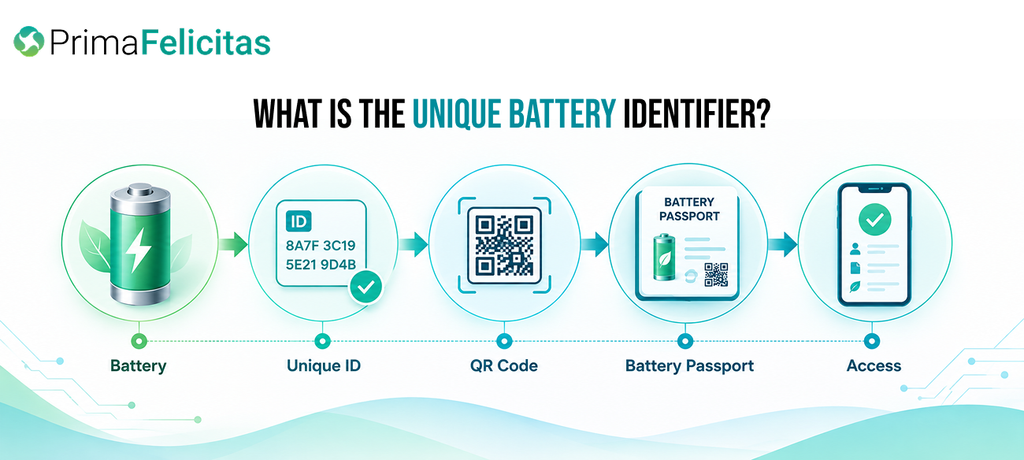
What is the unique battery identifier?
The unique identifier connects the physical battery with its Digital Battery Passport. The responsible economic operator must upload the required unique identifier to the EU DPP Registry. The identifier is, therefore, a key part of the physical-to-digital connection.
Does the Battery Passport Need a QR Code?
Yes, the Batteries Regulation requires the battery passport to be accessible through a QR code linked to the relevant unique identifier.
The data carrier provides the connection between the physical battery and its digital information.
Physical-to-digital flow
- Physical Battery
- QR Code
- Unique Identifier
- Digital Battery Passport
- Authorised Access
What Systems May Need To Be Integrated
Battery Passport data may come from several enterprise and operational systems.
| System | Possible Data |
| ERP | Product and business information |
| MES | Manufacturing information |
| PLM | Product and technical information |
| BMS | Battery performance and operational data |
| IoT | Operational and lifecycle data |
| Supplier systems | Material and component information |
| Recycling systems. | End-of-life information |
What are the data access requirements?
Battery Passport information is not necessarily available to everyone. Access depends on the type of information and the stakeholder’s rights.
| Access level | Example Users |
| Public | General Users |
| Restricted | Authorities and notified bodies |
| Legitimate interest | Eligible stakeholders with a legitimate interest |
Different stakeholders may need different information for activities such as repair, repurposing, remanufacturing, and recycling.
Does the EU DPP Registry Store the Complete Battery Passport?
No, the registry provides an EU-level registration and indexing layer. Detailed battery passport information follows the decentralized data architecture.
| DPP Registry | Battery Passport |
| EU registration layer | Detailed battery record |
| Unique identifiers | Battery information |
| Registration | Lifecycle information |
| EU-level infrastructure | Decentralized data |
Is Registry Registration the Same as Compliance?
No Registering a Battery Passport is one part of the overall process. A registration identifier does not by itself prove that the battery meets all applicable EU requirements.
Remember
Registration is not equal to compliance.
Compliance readiness
Correct Data + Required Passport + Identifier + Access + Applicable Requirements
What Happens If a Manufacturer Does Not Meet the Requirements?
Non-compliance can result in corrective measures and market enforcement.
Authorities may require:
- Corrective action
- Compliance measures
- Restriction of availability
- Prohibition of availability
- Withdrawal from the market
- Recall
Member States establish the applicable penalties under the Batteries Regulation.
Enforcement flow
Non-Compliance > Corrective Action > Restriction / Withdrawal / Recall
What Is the 2027 Battery Passport Compliance Checklist?
Manufacturers should verify that the key regulatory, data, and technical requirements are addressed before the mandatory date.
Quick checklist
- Battery category confirmed
- Responsible operator identified
- Required data mapped
- Data gaps identified
- Unique identifier defined
- QR/data carrier prepared
- Passport data model prepared
- Data validated
- Access controls defined
- Systems integrated
- Registry process prepared
- Testing completed
- Lifecycle update process ready
EU Battery Passport 2027 Requirements: Quick Facts
| Question | Answer |
| What is the battery | 18 February 2027 |
| Which batteries are covered? | EV, LMT and industrial batteries >2 kWh |
| Who is responsible? | Relevant economic operator |
| What is required? | Battery Passport + required data + identifier + access |
| Is a QR code required? | Yes |
| Does the Registry store all Passport data? | No |
| Can Registry registration prove compliance? | No |
| Can manufacturers test the Registry? | Yes |
| Does the Passport need lifecycle management? | Yes |
| What should manufacturers do now? | Identify → Map → Collect → Validate → Build → Test → Register → Maintain |
Frequently Asked Questions
When does the EU Battery Passport become mandatory?
18 February 2027.
Which batteries need a battery passport in 2027?
Electric vehicle batteries, LMT batteries, and industrial batteries above 2 kWh are within the scope of the requirement.
Who is responsible for the battery passport?
The economic operator placing the covered battery on the EU market or putting it into service.
What information must be included?
Required identification, technical, manufacturer, performance, sustainability, circularity and individual battery information, as applicable.
Does every battery need the same information?
No. Applicable data depends on the battery category and relevant requirements.
Does the Battery Passport need a QR code?
Yes. The required data carrier connects the physical battery with its digital passport.
Does the EU Registry store the complete battery passport?
No. It provides the EU-level registration and indexing layer.
Does registering the battery passport prove compliance?
No. Registration is only one part of overall compliance.
What happens if a manufacturer is not compliant?
Corrective action and market enforcement may follow, including restriction, withdrawal, or recall where applicable.
