
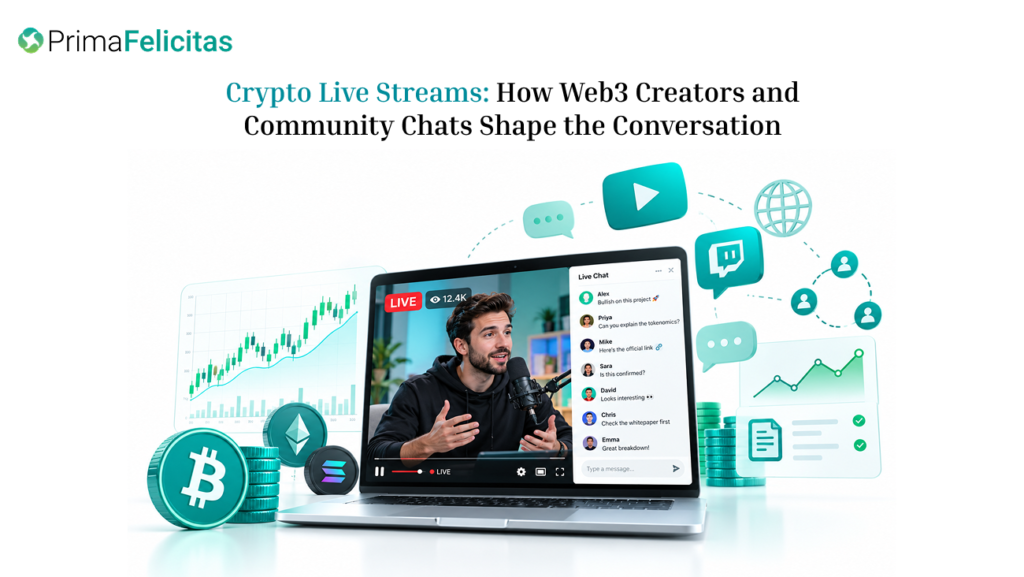
Crypto live streams can make a complex market easier to follow because viewers hear explanations, questions, and corrections as an event develops. They can also compress rumor, opinion, sponsorship, and fact into one fast conversation. The useful answer is not to accept or dismiss live commentary wholesale. Instead, treat a stream as a real-time source of hypotheses, then verify claims against primary documents, market data, and the creator’s incentives.
What Crypto Live Streams Add to Market Research
Live video offers context that a static post often lacks. A host can explain terminology, respond to a viewer’s question, and update an interpretation when new information appears. The format also exposes uncertainty in real time: a careful speaker may distinguish a confirmed announcement from a working theory, while a less careful one may move between the two without warning.
The social setting changes how information travels. Chat participants can supply links, challenge assumptions, or introduce a rumor before anyone has checked it. That speed is useful for discovery but weak as a verification standard. A message repeated by many viewers is still one unverified claim unless the underlying evidence is available.
Viewers should also separate three roles that often overlap: educator, commentator, and promoter. An educator explains a mechanism; a commentator offers an interpretation; a promoter may have a commercial relationship or an incentive to attract attention. The same person can perform all three roles in one broadcast, so the audience must evaluate the statement rather than rely on the speaker’s confidence.
How Real-Time Narratives Form
Market narratives usually develop through a sequence. First, an event becomes visible: a filing, protocol update, listing notice, exploit report, or macro release. Next, commentators frame what it might mean. Viewers compare the frame with price action, then repeat or challenge it in other communities. By the time an official clarification arrives, the initial interpretation may already have shaped expectations.
The sequence explains why a compelling story can move attention before it moves fundamentals. A host may connect several true details into a conclusion that is plausible but not yet demonstrated. The audience then treats the coherence of the story as evidence. Good research reverses that order: identify the claim, locate the source, test the timing, and state what remains unknown.
Language is an important signal. “The team announced” is a factual claim that should point to a source. “This could improve access” is an interpretation. “The token will rise” is a forecast with substantial uncertainty. A trustworthy discussion keeps those categories visible instead of presenting a prediction as a fact.
Choosing a Stream and Reading the Chat Carefully
A live crypto section can help readers find conversations organized around digital-asset events, but discovery should not be confused with endorsement. Before relying on a segment, check whether the host identifies sponsorships, distinguishes personal opinion from reporting, and corrects mistakes in public.
The chat itself has signals and failure modes. Repeated ticker symbols, emotional language, and coordinated calls can indicate attention, not independent confirmation. A useful comment includes a source, a precise question, or a falsifiable observation. A comment that only repeats urgency adds little evidence even if it receives many reactions.
A simple source scorecard can improve discipline:
| Question | Stronger signal | Weaker signal |
|---|---|---|
| Is the claim sourced? | Link to an original notice or document | “People are saying” |
| Is the speaker’s role clear? | Sponsorships and affiliations are disclosed | Commercial interest is vague |
| Are corrections visible? | Errors are acknowledged and updated | Old claims remain unqualified |
| Is market data defined? | Pair, venue, period, and timestamp are stated | A screenshot has no context |
The scorecard is not a credibility guarantee. It simply makes the evidence standard explicit before a viewer carries a claim into another conversation.
Where Web3 Social Media Fits
Many viewers discover streams through web3 social media, community servers, newsletters, and short-form clips. Each channel changes the information. A long stream may contain a qualification that disappears in a thirty-second excerpt. A repost may omit the timestamp or turn a conditional statement into a headline.
The practical response is to preserve the original context. Save the full clip, note when it was recorded, and identify the exact sentence that supports the claim. If a post links to a document, open the document rather than relying on the summary. This matters especially for governance proposals, token unlocks, security incidents, and regulatory developments, where the details often determine the conclusion.
Cross-platform repetition can create an illusion of independent confirmation. Five accounts may all be quoting the same first post. Count sources, not reposts, and ask whether any source has direct access to the underlying information. The goal is not to distrust every community; it is to avoid mistaking distribution for corroboration.
A Viewer’s Verification Workflow
Use this routine during or after a live discussion:
- Capture the claim. Write the exact statement, timestamp, asset, and event being discussed.
- Classify it. Mark it as a confirmed fact, interpretation, forecast, or rumor.
- Find the source. Prefer an official notice, filing, technical documentation, or clearly identified data provider.
- Check the market reference. Match the pair, venue, time window, and whether the chart is spot or derivatives data.
- Look for disconfirming evidence. Search for a correction, a different jurisdiction, a delayed implementation, or an alternative explanation.
- Decide what action is outside scope. If the evidence is incomplete, record the uncertainty instead of converting urgency into a trade instruction.
This workflow preserves the useful speed of a stream while adding the slower steps that a live format cannot always provide. It also helps editors quote a discussion accurately: a statement can be attributed as commentary without being presented as verified fact.
Risks, Incentives, and FAQ
Live discussion has technical and behavioral risks. A stream can lag, lose audio, cut context, or show a delayed chart. Hosts may use affiliate links, hold assets, accept sponsorships, or benefit from attention even when they do not make an explicit recommendation. Viewers in different jurisdictions may also face different rules, product access, and disclosure standards.
There is also a timing risk. A live host may be answering a question based on information that changes while the broadcast is still running. Clips can then circulate after the correction, leaving the first version easier to find than the qualified version. Saving the timestamp and checking for follow-up comments is a small but useful safeguard when a discussion may influence reporting or personal research.
Language and translation create another boundary. A stream may summarize a document in one language while the binding terms, filing, or warning appear elsewhere. Viewers should confirm that an apparent disagreement is not a translation shortcut or a difference between jurisdictions. When a claim affects access, compliance, or custody, the original wording deserves priority over a fast paraphrase.
FAQ
Are crypto live streams reliable for breaking news?
They can help locate a development quickly, but reliability depends on sourcing and correction practices. Verify the original announcement before treating the discussion as evidence.
How can I spot paid promotion?
Look for sponsorship labels, affiliate disclosures, repeated product mentions, and language that promises certainty. If the relationship is unclear, treat the segment as promotional commentary rather than independent analysis.
Should chat sentiment influence a decision?
Sentiment can show what a community is discussing, but it does not establish facts, liquidity, or suitability. Use it as a research lead only.
What if a streamer refuses to show sources?
You can still listen for ideas, but lower the evidentiary weight of unsupported claims. A confident delivery cannot substitute for a document, dataset, or clearly defined observation.
Conclusion
Live streams are valuable because they connect events, explanations, and questions in real time. Their weakness is the same speed: claims can outrun evidence, and repetition can look like confirmation. Viewers get the most value by treating broadcasts as a map of issues to investigate, preserving the original context, and separating sourced facts from interpretation and promotion. That approach keeps community discussion useful without turning it into an automatic decision rule.
Turn crypto live streams into reliable research—verify claims, track sources, and separate facts from hype in real time. Contact PrimaFelicitas to build community-driven Web3 market intelligence tools.
