
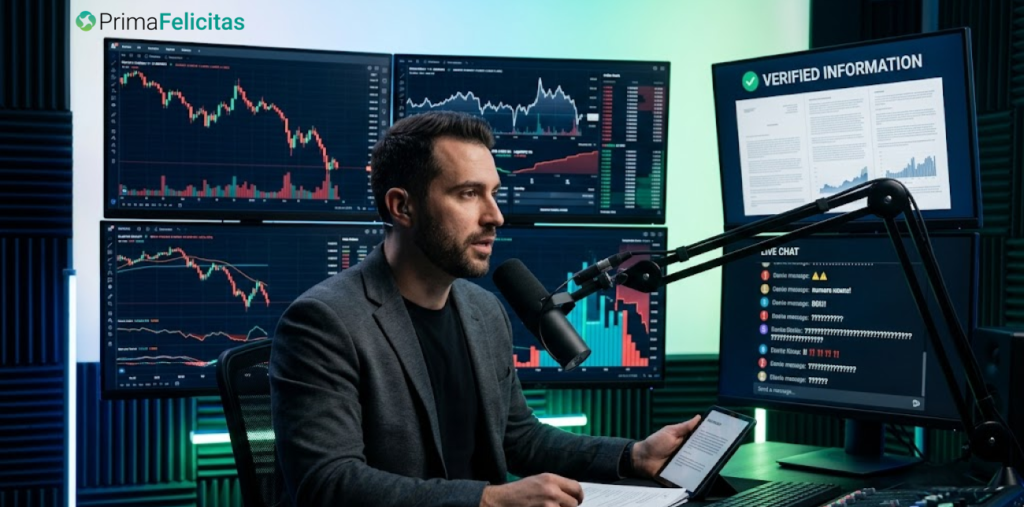
When a coin drops 10% in minutes, the chart tells you what happened, but not why. The cause may be an official announcement, a thin order book, a broader risk-off move, or a rumor spreading through chat. A live discussion can help, but only if it turns speed into questions rather than certainty.
I judge a live stream by what it helps me verify after the broadcast. Does the host identify the source, separate a fact from an explanation, give a time frame, disclose a position or sponsorship, and correct mistakes when new information arrives? Those signals matter more than a confident price target.
What Crypto Live Streams Add to Market Data
When prices move quickly, market data tells us what changed but not always why. A sharp decline may follow a regulatory notice, a token unlock, a liquidity problem, a technical failure, or a broader risk-off move. The percentage change can look similar in each case, but the next question is different. Context helps viewers decide what to check first.
Crypto streaming can add that context by showing how questions develop as information arrives. A useful host may read an exchange notice, timestamp the update, compare price and volume across venues, and distinguish a pause in deposits from a suspension of withdrawals or trading. The value is not speed alone; it is the connection between an original source and its practical effect.
That format also has a built-in risk. A fast chat can reward a convincing explanation before anyone tests it, and a commentator can sound certain because the facts are incomplete. Look for a source, a stated unknown, and a clear next check. If the stream cannot tell you what would change the view, it is entertainment with market vocabulary, not analysis.
Live Streams and Commentary Do Different Jobs
A live stream emphasizes timing and interaction: the creator follows an event, answers questions, reacts to new information, and updates the discussion as the session develops. Commentary is more focused on interpretation. It may examine sentiment, price structure, volume, liquidity, or the possible effect of a news event. It can be live or recorded, but its main contribution is the reasoning behind a view.
Neither format is automatically more reliable. A lively stream can contain an untested opinion, while a polished commentary can hide weak assumptions. I pay attention to whether the speaker shows evidence, states the time frame, names the limits of the argument, and revises the view when facts change.
Disclosure matters too. A host who holds the asset, receives sponsorship, or benefits from referral activity should make that clear. A disclosure does not invalidate a discussion, but it helps the audience interpret the incentives behind the strongest claims.
A Real Example: USDC’s March 2023 De-Peg
A useful test came during the March 2023 banking stress, when USDC traded below its $1 target after Circle disclosed that $3.3 billion of its cash reserves were held at Silicon Valley Bank. Circle’s official update said the reserve deposit would be available after regulators announced that depositors would be made whole, and the company continued to publish operational updates. A stream that simply declared “USDC is failing” would have skipped the central question: was the market pricing a permanent reserve loss, or a temporary liquidity and redemption problem?
The better live discussion would show the timestamp, quote the original notice, compare the price gap across venues, and explain what evidence would distinguish a lasting solvency problem from a short-term market dislocation. It would not need to predict the next candle. Its job would be to help viewers follow the facts as they changed and avoid treating the first explanation in the chat as the final one.
Five Questions for Evaluating a Live Market View
1. What exactly is being claimed? Is the speaker reporting a confirmed event, offering a possible explanation, or predicting a price? A fact, a hypothesis, and a forecast need different standards.
2. Does the evidence match the claim? A chart can show price and volume; an official notice can confirm a service change; an on-chain record can answer another question. Ask for the source that can actually support the statement.
3. What is the time frame? A view about the next few hours is not a long-term assessment. Note the timestamp, when the claim should be reviewed, and what would count as support or failure.
4. What incentives and risks are visible? Look for sponsorships, holdings, referral links, leverage, liquidity conditions, and the information the speaker does not have. Risk should affect the reasoning, not arrive as a final disclaimer.
5. What will you verify independently? Use market data, official project or exchange announcements, and reliable records to check the claims that matter. Live content can point you toward an investigation; it cannot replace one.
Use Commentary Without Following Predictions Blindly
For broader context, readers can explore crypto commentary covering sentiment, technical levels, major assets, and current developments. Give each source a different job: use live discussion to find the questions people are asking, market data to check what changed, official announcements to verify facts, and longer-form research to understand the background. This separation makes it easier to notice when confidence has outrun evidence.
Also watch what happens after the prediction. Does the commentator return to the claim, explain what changed, and correct an earlier assumption? A single accurate call proves very little; a transparent record of calls, misses, and revisions tells you more.
Presentation can make a weak argument sound complete. The useful signal is usually less dramatic: a timestamp, a source, a stated uncertainty, or a correction made in public.
The Value of Better Questions
Live crypto content cannot remove volatility or predict every market move. Its durable value is narrower: it can help people understand an event while it is developing, compare interpretations, and identify the evidence needed to test a claim. That is less exciting than a precise forecast, but more useful when the facts are still changing.
Treat market discussions as information and analysis, not financial advice. Verify material claims, consider the risks of the asset and platform, and account for your circumstances. The best discussion does not promise certainty; it shows you where certainty ends and what to check next.
